


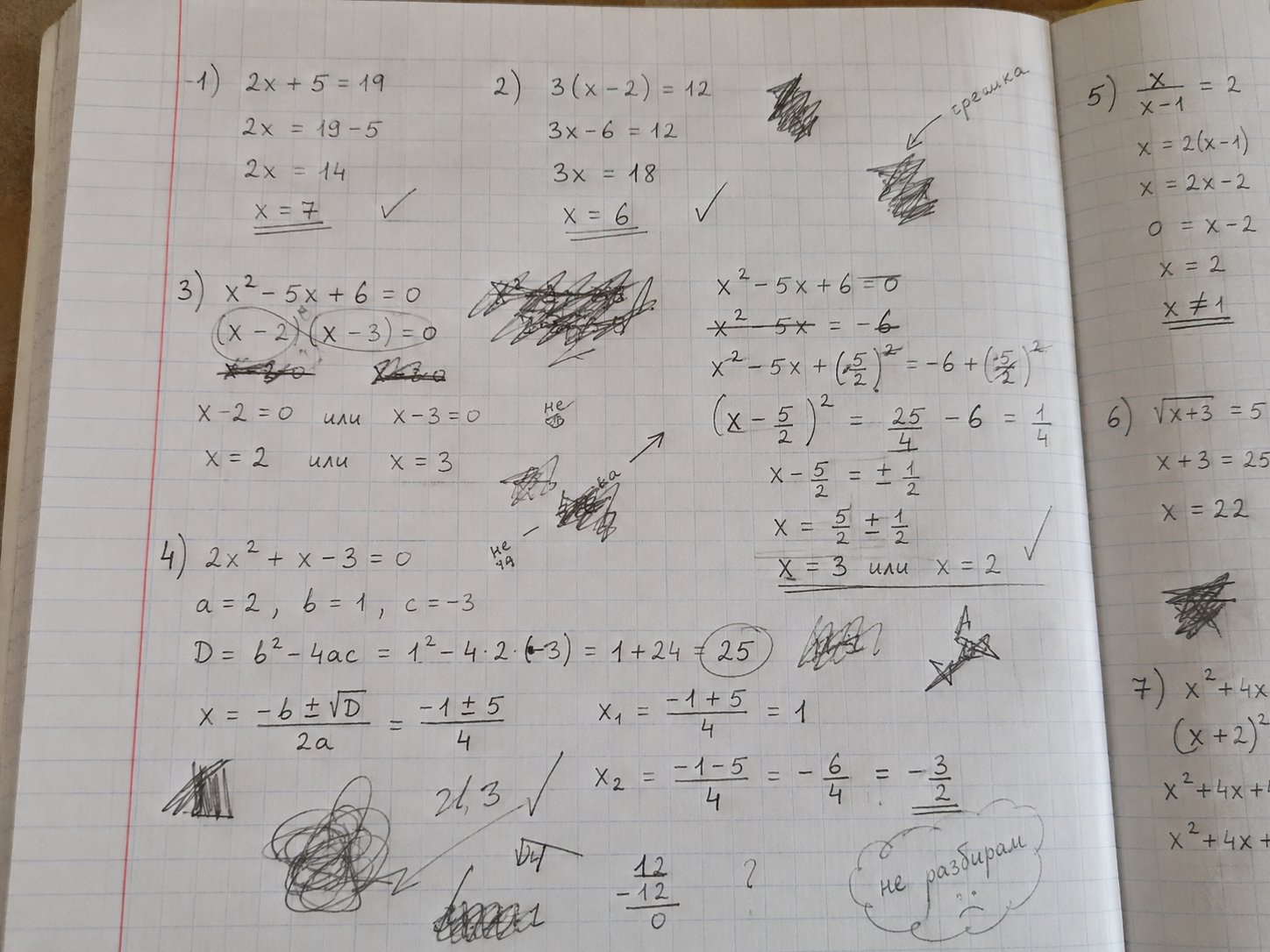
A child from a close family is one of those children about whom we say, ‘Maths isn’t his strong point’. His father noticed, when he was about 5 years old, that he didn’t understand the concepts of ‘bigger’ and ‘smaller’ numbers. He somehow managed with addition, albeit by counting on his fingers, but subtraction was a real struggle, and any understanding of the ‘difference’ between two numbers was simply absent.
At school, when they got to the multiplication table, he learnt it by heart like a poem, but without really understanding it. His parents spoke to his teacher about how he seemed to be guessing the answers rather than grasping the logic and working out the solution himself.
After a great deal of struggle both at school and at home, his father began searching online to find out why this might be happening, and that’s how he came across the term ‘dyscalculia’. It is often referred to as ‘dyslexia for maths’, because both are neurological differences in the way the brain processes information.
A diagnosis of dyscalculia is made by psychologists and speech and language therapists based on prolonged observation of a combination of the following:
- The child continues to count on their fingers long after their peers have stopped and finds it difficult to remember mathematical principles.
- They struggle to link the symbol (the number ‘3’) with the quantity (three objects).
- They mix up the positions of digits in larger numbers and do not grasp the difference between ‘a lot’ and ‘a little’.
- They get lost in multi-step problems or those involving money, time or distances.
- And — often the most obvious sign — they start avoiding anything to do with numbers, get nervous, or feign stomach aches before a maths lesson.
How common is it? More common than most people realise. Research suggests that dyscalculia affects around 5 to 7 per cent of people — roughly one child in every classroom. It affects boys and girls equally and often has a hereditary component.
However, it is discussed far less than dyslexia. That is why so many children reach the upper years without anyone realising why maths is such a struggle for them.
The child in this story has not been diagnosed with dyscalculia. The father spoke to the speech and language therapist his son was seeing, and she began to take an interest in dyscalculia and to adapt her work with him based on what she had learnt. For her, this was her first professional experience with dyscalculia. The teachers at school heard about the existence of such a condition for the first time from the father. The support teacher mainly ensures the child does his homework during their sessions together, so no help with the problem comes from that direction.
The father spoke to friends about dyscalculia and, apart from the usual comments such as ‘he doesn’t look at all like a child with special educational needs’ and ‘enough with these labels’, he also came across a family of friends who also have a child with this condition. However, they live in Spain, where the diagnosis was made at school and the child was assigned a support teacher who sits beside him in class and explains the maths material to him in language he can understand. The child’s father is a physicist who is brilliant at maths, but as it turns out, that’s no guarantee of anything.
Understanding the diagnosis helps to shift to a more effective approach. Numbers become more accessible when they are tangible — buttons, blocks, coins, or cooking with measuring jugs. Allow more time for solving problems and for mastering the material – for example, just because they know that 10–2 = 8 doesn’t mean they can apply that to 100–20. And it’s important to celebrate the effort, not just the correct answer.
And perhaps most importantly: protect their self-esteem. A child who believes they’re ‘bad at maths’ stops trying. A child who knows that their brain simply works differently and that there are ways to cope will carry on.